Best Gym Management Software - Starting at ₹699/month
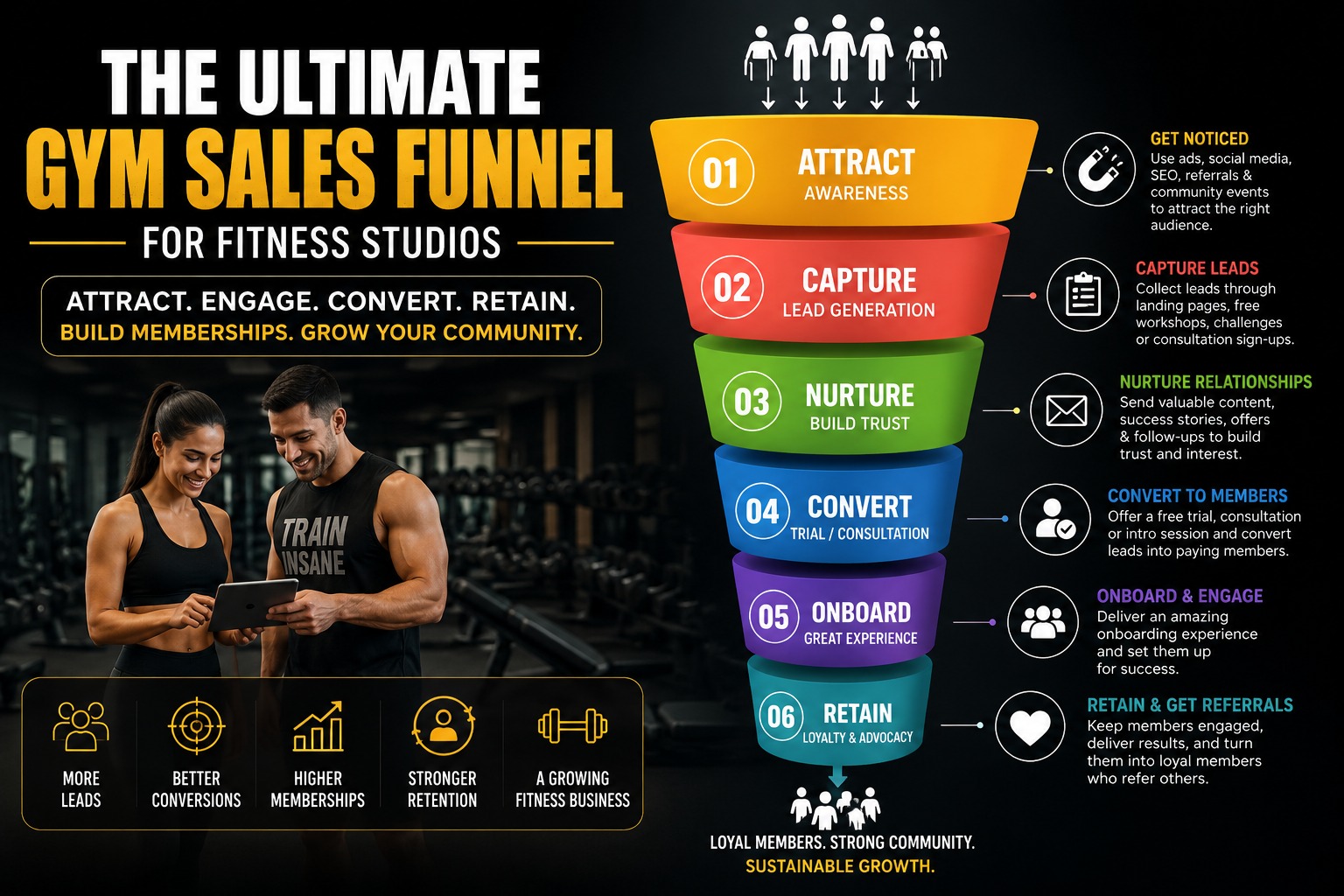
Most studios already run ads, post on Instagram, and hand out trial passes. What they lack is a system connecting those activities into stages that get measured.
A gym sales funnel is the structured path a prospect follows from first hearing about a fitness studio to becoming a paying member, typically moving through awareness, interest, trial, and conversion stages. Each stage uses a specific offer or touchpoint, such as a free class or a follow-up message, to move the prospect closer to signing up.
This guide covers the four funnel stages, the offers that move people through each one, and the follow-up and tracking work that decides whether a trial visitor becomes a paying member.
In This Guide
- What Is a Gym Sales Funnel?
- Why Most Fitness Studios Lose Members Before They Ever Convert
- The 4 Stages of a Gym Sales Funnel
- Offers That Actually Move Prospects Through the Funnel
- Automating Follow-Up So Leads Don't Go Cold
- Tracking Funnel Performance the Right Way
- Building the Funnel Into Your Gym Software Stack
- FAQ
- Further Reading
What Is a Gym Sales Funnel?
A gym sales funnel is not a single campaign or a stack of Instagram ads. It's a defined sequence: a prospect enters at awareness, moves to interest once they engage with an offer, reaches a decision point during a trial, and either converts or drops off. Each stage has its own goal, channel, and drop-off rate that can be tracked separately, which is what separates a funnel from a marketing plan. A marketing plan tells you what to post; a funnel tells you where prospects are falling off between the ad click and the signed membership.
Why Most Fitness Studios Lose Members Before They Ever Convert
Ask most studio owners where their funnel breaks and they'll point to advertising: not enough leads, not enough reach. The bigger leak usually sits further down, at follow-up.
A prospect books a trial class through an ad, forgets or gets nervous, and no one calls to reschedule. That lead is gone not because the ad failed, but because nothing caught the drop-off between "booked" and "showed up." The same pattern repeats after the trial: a prospect has a good experience and leaves without a clear next step because the front desk was busy. Without follow-up within a day or two, interest cools.
Your Digital Lift doesn't have a published benchmark for show-up-rate lift from automated reminders to cite here, so this section won't invent one. The consistent pattern: leads are lost to silence between stages, not to weak top-of-funnel marketing.
The 4 Stages of a Gym Sales Funnel
The stages follow the AIDA model — Awareness, Interest, Decision, Action — adapted to a fitness studio.
Awareness
A prospect needs to know the studio exists before anything else happens. Local SEO, geo-targeted social ads, and referral programs from existing members all feed this stage.
Interest
Awareness gets attention. Interest gets contact information — a lead magnet, a free downloadable workout guide, or a "book your free consultation" form.
Trial and Decision
This is where studios lose the most prospects. A trial class or a 7-14 day trial period gives the prospect a real, hands-on experience with the trainer and the studio's atmosphere, not a sales pitch about it.
Action and Conversion
The final stage needs to remove friction, not add a form. Instant digital sign-up and real-time payment (UPI support matters for studios operating in India) separate a studio that converts quickly from one that loses trial visitors to paperwork delay.
Internal link opportunities: a related post on lead generation for fitness studios, and this platform's product/pricing page, once published/linked.
Offers That Actually Move Prospects Through the Funnel
Different studio types convert on different offers. Matching the offer to the format matters more than discount size.
Free First Class
Low commitment, high curiosity. Best for group fitness, martial arts, and yoga studios where the class format is the sell.
7-Day Trial
Enough time to try more than one class type and start forming a routine.
14-Day Trial
Better for studios where results take longer to notice, such as strength training or reformer Pilates.
Free Fitness Assessment or Consultation
Positions a trainer as an expert first, sale second. Best for personal training studios.
Refer-a-Friend Discount
Turns existing members into an acquisition channel; referred leads convert higher than cold ad traffic since trust is already established.
Automating Follow-Up So Leads Don't Go Cold
The stage most studios skip is also the cheapest to fix. A basic sequence:
Day 0 — Booking Confirmed
Instant WhatsApp/SMS confirmation with class time, location, and what to bring.
Day 0 — Two Hours Before Class
Reminder with a one-tap reschedule link.
Day 1 — Post-Trial
Thank-you message from the trainer with a direct sign-up link.
Day 3 — No Conversion Yet
A second follow-up, ideally from a different staff member, asking if they have questions rather than pushing the sale again.
The mechanism matters less than the consistency: every booked trial gets the same sequence, every time, without depending on whether the front desk remembers.
Tracking Funnel Performance the Right Way
A funnel only earns its name if it's measured stage by stage, not just by total memberships sold at the end of the month.
| Metric | What It Tells You | Check Frequency |
|---|---|---|
| Cost per trial booking | Whether awareness spend is efficient | Weekly |
| Trial-to-membership conversion rate | Whether the trial and follow-up stages are working | Weekly |
| Drop-off rate by stage | Exactly where prospects are leaving the funnel | Monthly |
| Channel-level ROI | Which source (ad, referral, walk-in) is worth the spend | Monthly |
A studio with lots of bookings but a low trial-to-membership rate doesn't have an awareness problem, it has a follow-up problem — and the fix is Stage 3, not a bigger ad budget.
Building the Funnel Into Your Gym Software Stack
Running this funnel across five disconnected tools — an ad platform, a lead spreadsheet, a messaging app, a paper waiver stack — is where the tracking above turns into guesswork. When CRM, automated messaging, attendance tracking, and payment collection live in one system, every stage becomes a number an owner can pull up, not estimate.
That's the practical role a gym management platform plays: making sure a booked trial, a sent reminder, and a completed payment are all recorded against the same lead record, instead of scattered across tools that don't talk to each other.
FAQ
Further Reading
- GoTeamUp: What is a gym sales funnel, and why do you need one?
- Wellness Creatives: Create a Gym Sales Funnel That Generates Leads & Revenue
No government or peer-reviewed source applies directly to this commercial marketing topic. The two sources above are the most credible industry references identified.